

How to Open a Bank Account in Australia
Learn how to open a bank account in Australia: eligibility, documents, fees, and step-by-step process for residents, expats, and students.

Updated 2025 list of red, yellow & green zone banks in Bangladesh. Find which banks are safe, at risk, or restricted by Bangladesh Bank.
“If you don’t know who’s swimming naked, wait until the tide goes out.”
— Warren Buffett
That quote? It fits Bangladesh banking sectors like a tailored punjabi during Eid. For years, many banks in this country looked fine on paper. But by 2025, the tide has pulled back, and now, we finally see which banks are rock solid, which are barely floating, and which are hanging by a thread (or a merger plan).
When it comes to financial health, nothing is clearer than the official red, yellow, and green zone banks list in Bangladesh 2025. This classification shows which banks are safe and stable, which ones are under pressure, and which are in critical condition.
If you’re planning to open a business bank account here, or you’re a foreigner browsing the legal setup process, understanding the banking zones is no longer optional. It’s your due diligence shortcut, especially if you’re stepping into BEZA, Hi-Tech Parks, or trying to get a startup loan as a foreign entrepreneur.
So let’s decode this map: Red Zone, Yellow Zone, and Green Zone with plain talk, current data, and zero marketing makeup.
Let’s face it: banking in Bangladesh isn’t just about interest rates and service charges anymore. In 2025, it’s about survival, stability, and scrutiny. Every bank, government, or private, is now walking under a spotlight, thanks to the Bangladesh Bank’s health-check system, which has quietly but firmly sorted banks into three performance zones:
But what does this actually mean?
Let’s break it down; simply, clearly, and like you’re sitting with someone who works in banking but still remembers what a queue at the ATM feels like.
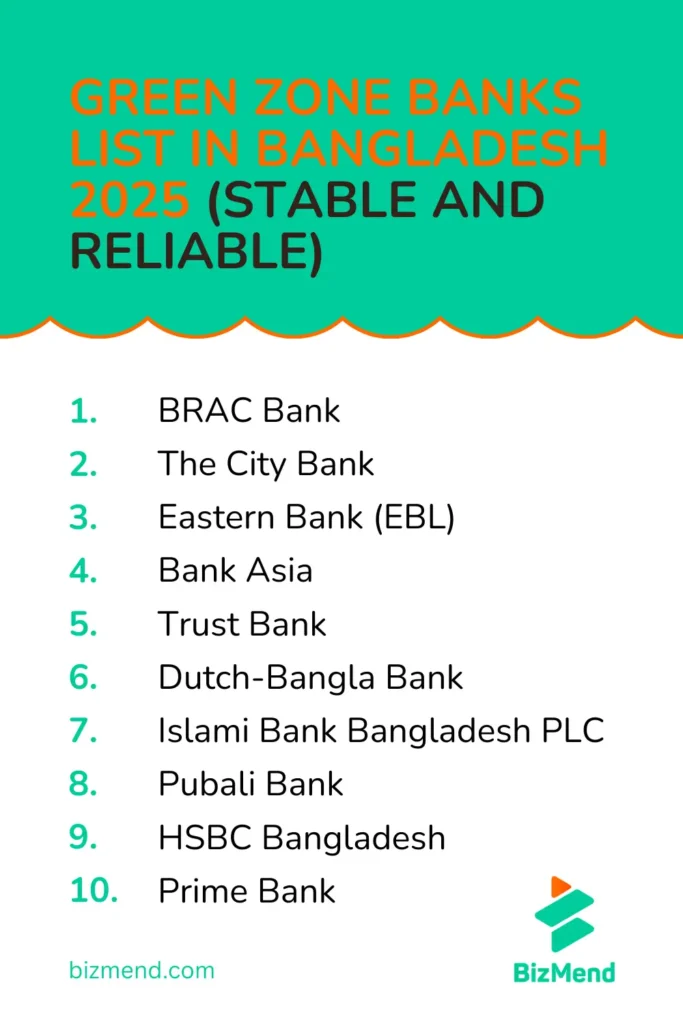
Let’s talk about the stars of the list first: the green zone banks. These are the banks that the Bangladesh Bank still trusts. They’ve passed the stress tests. Their balance sheets are in order. And if you’re a business owner, especially a foreign entrepreneur, you’ll want to start your journey here.
What defines a Green Zone bank?
Banks in the Green Zone (2025):
Why They Matter:
If your search history includes: “how to start a business in Bangladesh,” “how to open a business bank account in BD,” or “SME loans for foreigners,” start with these.
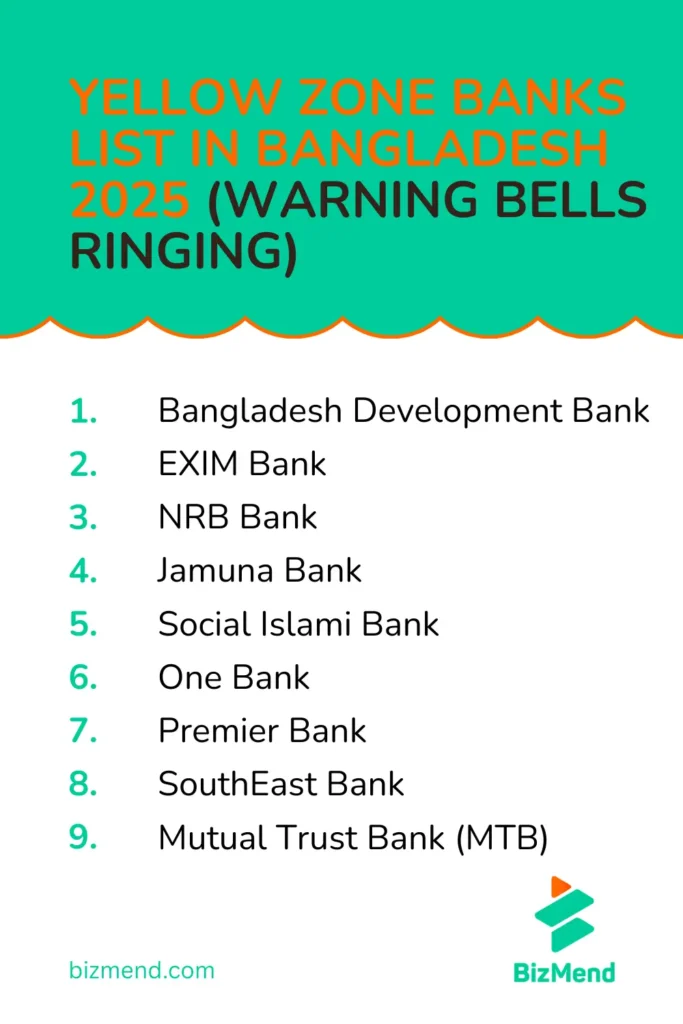
Not drowning, but definitely coughing. Yellow Zone banks are under close watch. They still operate normally, but with issues like high non-performing loans, weak governance, or capital strain.
What lands a bank in the Yellow Zone?
Banks in the Yellow Zone (2025):
What’s Going On:
Heads up: These banks still serve clients, but with caution flags. If you’re seeking start-up loans or registering a new company, Yellow Zone banks may delay approvals or offer reduced limits. So, if you must bank with them, check their current standing, ask for credit ratings, and avoid long-term deposits unless you’re fully informed.
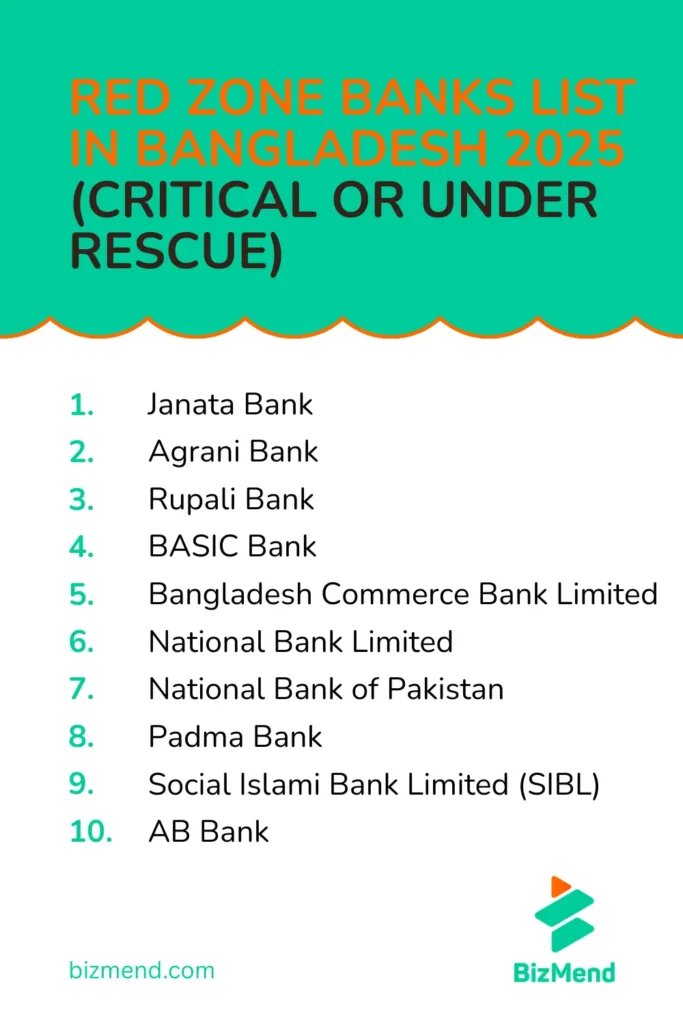
This is the “do not touch unless you must” list.
Bangladesh Bank’s Financial Stability Department has red-flagged these for structural weakness, operational failure, or insufficient capital buffers.
What qualifies a Red Zone Bank?
Banks in the Red Zone (2025):
What It Means:
Pro Tip 1: If you’re a foreigner planning to invest, repatriate capital, or open large-scale business accounts, avoid banks in this category unless you have insider knowledge or serious legal coverage.
Pro Tip 2: Interested in learning more about Bangladesh’s banking sector? Check out our blogs on Bangladesh’s Government, Private, and Foreign banks.
This zoning list isn’t permanent.
Bangladesh Bank’s zone classifications can shift over time; sometimes quietly, sometimes publicly. A bank that’s “green” today might slip into yellow six months from now due to capital issues, governance gaps, or loan defaults. Similarly, a red-zoned bank may recover post-merger or under new leadership.
What influences the zone shifts?
So always check the latest Bangladesh Bank circulars, reputed local news sources, or consult an expert before making big commitments, especially if you’re a foreign investor setting up shop here.
Think of this blog as your snapshot, not the whole CCTV footage.
Let’s be honest: if you’re a foreigner trying to do business in Bangladesh, you’re not just picking a bank. You’re picking your first partner in paperwork.
Whether you’re:
Your bank’s zone status matters.
Why? Because the green zone banks, think the BRACs, City Banks, Trusts of the world, don’t just issue account numbers. They understand what you’re actually trying to do. They’re already familiar with capital injection rules, director due diligence, remittance certificate protocols, and export-import credit needs. Which means:
And yes, applying for a work permit or business visa extension? Green zone banks will give you the account maintenance letters and payment records you need, without the mysterious delays red-zoned banks are becoming infamous for.
So, while you weigh your setup costs or explore your tax plans, don’t treat banking as an afterthought. In Bangladesh, the bank you choose becomes part of your legal footprint, for better or worse.
And that, dear folks, makes zone awareness not a luxury, but a survival instinct.
These zones aren’t just some fancy tags; they’re how Bangladesh Bank tells the solid banks apart from the ones walking on thin ice.
Each zone gives you a peek into how financially sound a bank is, how much risk it’s carrying, and how well it’s being run, based on red flags like bad loans, capital cushion, and how responsibly it’s managed.
These categories are based on insights from Bangladesh Bank’s Financial Stability Report and off-site monitoring. While the full list isn’t made public, trustworthy media sources, internal meetings, and confirmed banking data leaks help give us a clear picture.
If you’re planning to open an account, transfer capital, or repatriate profits, knowing the zone is less of a tip and more of a warning label.
Throughout this blog, you’ve seen one name crop up again and again: Bangladesh Bank. Whether it’s placing a bank in the red zone, hinting at mergers, or keeping an eye on non-performing loans, this central institution quietly anchors the country’s entire financial system.
But why does it have so much say? And why should you, whether a founder, a remitter, or a first-time investor, pay attention to what the Bangladesh Bank declares?
Why Bangladesh Bank actually matter? Well, let’s talk some facts here:
So when Bangladesh Bank puts a bank under observation, it’s not just a bureaucratic move; it’s a signal to entrepreneurs, citizens, and even foreign stakeholders to either lean in or steer clear.
Without Bangladesh Bank’s steady hand, the zones we’ve discussed wouldn’t mean anything. With it? They’re a crucial financial compass.
The colors aren’t just labels; they’re warnings, welcomes, or warnings wearing makeup.
And in Bangladesh’s banking scene, that traffic light metaphor could save you more than time; it could save your capital, credibility, and sanity.
“Risk comes from not knowing what you’re doing.”
— Warren Buffett
So before you walk into any bank and sign the dotted line, read the zone it’s in. Because here, the shade of your bank’s zone could shape your entire business story.
Answer: Think of it like a traffic light, but for your money.
And trust me, when you’re trying to run a business, the last thing you want is your bank playing musical chairs with mergers.
Answer: Let me be straight with you: yes.
Even if they’re still open, Red Zone banks often face internal issues: frozen credit lines, poor service, delayed remittance processing, or even stricter oversight. You may not lose your deposit overnight, but you’ll likely lose peace of mind every other day.
So, unless you’re absolutely sure of every step, or have no better option, it’s best to hold off.
Answer: Absolutely.
Bangladesh Bank updates these classifications strictly based on performance, liquidity, and compliance. A Yellow Zone bank today might make a comeback, or slip further into the Red. That’s why it’s smart to re-check before renewing major deposits or applying for business loans next year.
Zone status is like a health checkup. It’s not permanent, but it’s a serious warning when it’s bad.
Answer: Short answer: Yes, you should, especially in your first year.
Green Zone banks like BRAC, EBL, Sonali, or City Bank already understand how to handle BIDA letters, foreign currency accounts, capital repatriation… all that paperwork foreigners often wrestle with.
Start safe. You can always diversify later.
Answer: Good question, and a tough one.
Some Yellow Zone banks are big on branding but struggling behind the scenes with bad loans, weak audits, or expansion they couldn’t digest. Being popular doesn’t always mean being strong. That’s why the zone chart matters more than the logo.
Answer: Because someone has to call out when things are quietly going wrong.
Bangladesh Bank doesn’t run ads or post flashy updates on social media, but it does constantly and strictly audit how healthy each bank is. The red, yellow, and green zoning system helps them, and all of us, track which banks are operating safely, which are slipping, and which might already be in trouble. It’s based on real metrics: capital strength, loan defaults, asset quality, and how responsibly a bank manages money.
Think of it like health check-ups; only here, your savings, salaries, and investments are on the line.
Answer: It can. And sometimes, it must.
The Bangladesh Bank has the complete legal authority to step in when a bank poses a risk to the financial system, whether it’s from reckless lending, fraud, or just bad management. If a bank is deeply in the red zone and shows no sign of improvement at altogether, Bangladesh Bank can block it from disbursing new loans, recommend management changes, or even push for mergers with stronger institutions.
But it doesn’t act overnight. It gives warnings, monitors closely, and tries internal correction first. Only when public money is truly at risk, it acts. With protection, of course, not punishment, in mind.

Learn how to open a bank account in Australia: eligibility, documents, fees, and step-by-step process for residents, expats, and students.

Learn how to open a bank account in Pakistan: eligibility, documents, fees, and step-by-step process for residents, expats, and students.

Choose smarter with the Top 10 private banks in Singapore—ranked by AUM, digital maturity, awards, and local presence; compiled from…