

How to Open a Bank Account in Australia
Learn how to open a bank account in Australia: eligibility, documents, fees, and step-by-step process for residents, expats, and students.

Find out what are Non-Bank Financial Institutions in Bangladesh , how they work, operate , and why they’re different from banks.
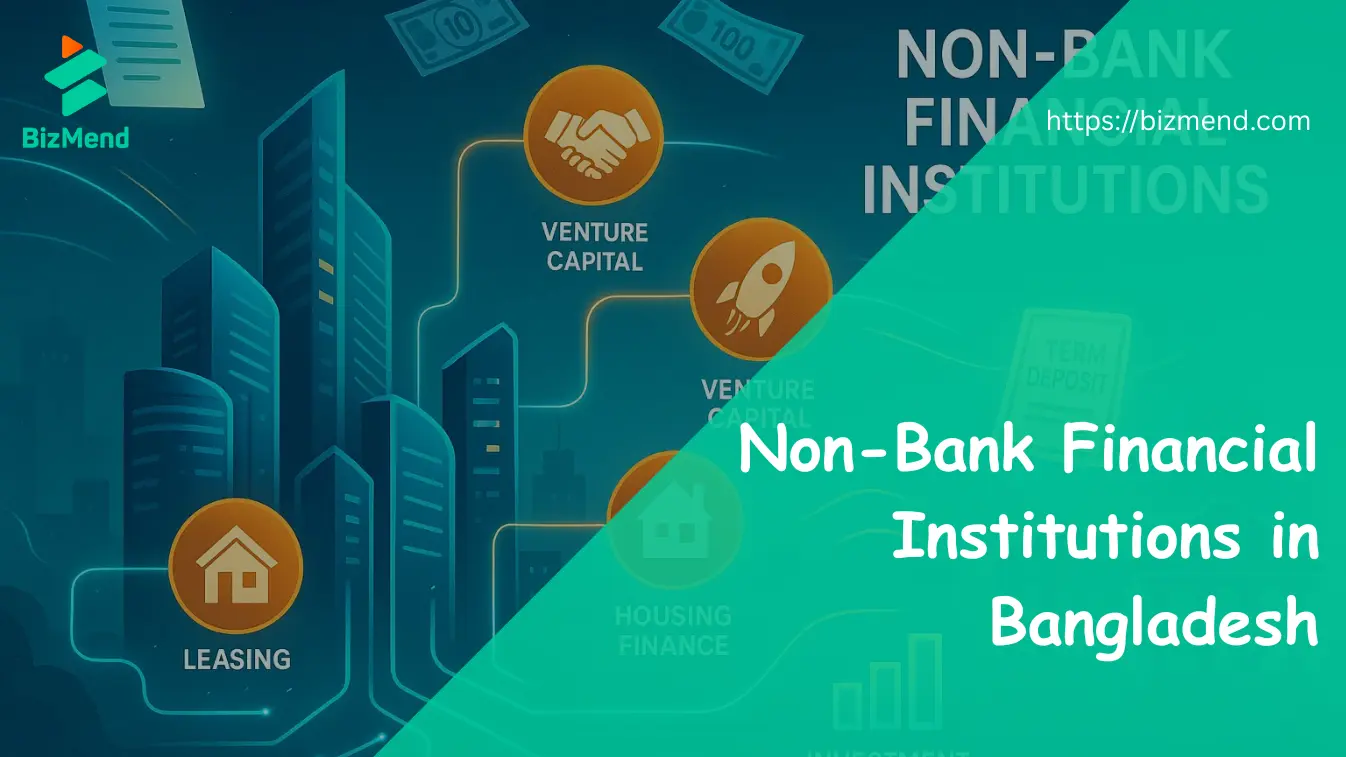
“If banks are highways, NBFIs are the winding roads that reach the places highways can’t.”
Banks handle the mainstream money flow—but Non-Bank Financial Institutions (NBFIs) reach where banks often can’t. They’re the quiet players funding leases, long-term projects, and high-risk ventures that banks hesitate to touch. In Bangladesh, there are 35 licensed NBFIs, and among them, 9 play a major role in driving economic growth—powering industries, entrepreneurs, and investors who need more flexibility than traditional banks can offer.
If you’ve ever needed growth capital, custom financing, or investment options beyond standard loans, NBFIs might be exactly what you’re missing. In this guide, you’ll discover how these institutions operate, how they’re evolving with the economy, and what truly sets them apart from your typical bank.
Not every financial story begins in a marble-floor bank branch. Some of the most critical lending, leasing, and business financing in Bangladesh happens quietly, through NBFIs.
Here are a few standout names from the 34 licensed NBFIs currently operating in the country:
IDLC Finance is one of the most well-rounded and trusted NBFIs in Bangladesh. From home loans to SME support, they’re known for doing things by the book and doing it fast.
LankaBangla Finance is a hybrid powerhouse. Their services range from auto loans to capital market investments. If you’re looking to raise equity or borrow for expansion, they’ve probably already done it before.
A favorite among young entrepreneurs and first-time homeowners. IPDC Finance has also been one of the rare institutions genuinely backing financial inclusion and putting real support behind women-led businesses.
BIFC focuses on industrial projects and the manufacturing sector growth. While some legacy issues exist, they remain relevant in targeted lending areas.
The name says it all; this is where housing dreams get their first approval. DBH is the go-to for long-term home finance, especially for salaried individuals and NRBs.
United Finance is known for long-standing relationships with businesses, especially in leasing and project-based finance. They also maintain a consistent presence outside Dhaka.
Bay Leasing & Investment offers leasing, capital market operations, and investment advisory services, popular among mid-sized enterprises.
Uttara Finance and Investments is active in everything from personal lending to corporate deals. They’ve handled some of the country’s most diverse client portfolios.
Strong focus on SME and startup lending. If you’re launching a new business in Bangladesh or expanding an existing one, MIDAS often shows up with solutions before traditional banks do.
Now, before getting into the details, let’s clear the very basics first. What exactly are NBFIs?
Non-Bank Financial Institutions, yep, that’s what NBFIs stand for, are companies that provide financial services like leasing, term loans, and investment management, but here’s the key: they’re not actual banks and don’t have a banking license.
Key Roles:
Banks usually take care of your savings and regular loans. NBFIs, though? They’re built for the more tailored, hands-on funding needs.
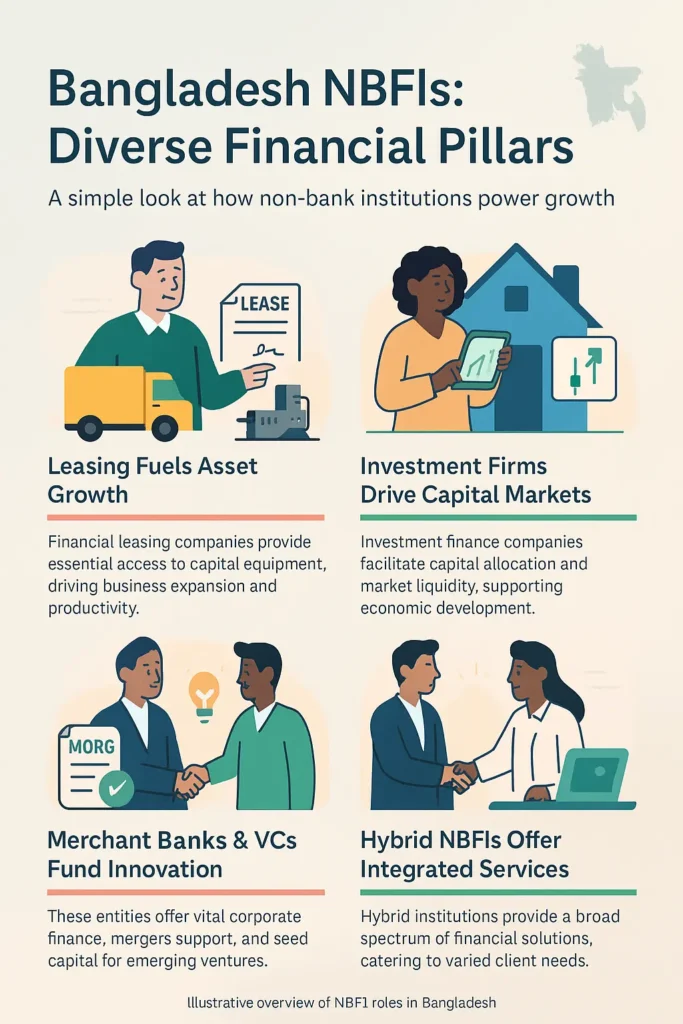
Even though they’re all regulated under the same umbrella, each one plays a different role, based on what they’re licensed to do and who they’re actually built to serve.
Here are the most common types of NBFIs you’ll find in Bangladesh:
These focus on leasing assets like machinery, transport vehicles, or industrial equipment. Instead of buying upfront, you pay monthly; great for businesses easing into big investments.
Example: Bay Leasing & Investment Limited
You can think of them as patient lenders, not quick-cash places.
They’re the ones who step in with long-term funding when the stakes (and price tags) are high; think manufacturing plants, highways, or heavy industry. More like steady, long-term lenders than quick cash merchants.
Example: Bangladesh Industrial Finance Company Limited (BIFC)
Home loans, apartment financing, and real estate development support—that’s their turf. Many NRBs and mid-income families rely on these institutions.
Example: Delta Brac Housing Finance Corporation (DBH)
These are the heavy hitters in equity investment, IPO management, and startup funding. They’re not as common, but they’re growing fast.
Example: CAPM Venture Capital and Finance Limited, SEAF Bangladesh Venture Ltd
Some institutions blur the lines, offering multiple services across leasing, lending, housing finance, and merchant banking under one roof. They’re diversifying to stay competitive.
Example: IDLC Finance Limited, LankaBangla Finance
Let’s be honest: on paper, both banks and NBFIs deal with money. But in practice? Their roles are not the same.
The difference between banks and non-bank financial institutions really comes down to three things: who can take your deposits, how much risk they’re willing to handle, and what kind of services they actually provide.
Commercial Banks: Commercial banks are allowed to accept demand deposits. Which is basically your regular checking accounts, straight from the public.
NBFIs: They can’t touch demand deposits, but they can offer term deposits, which are fixed-term investments that come with a set interest rate.
Banks: Heavily watched by the Bangladesh Bank to make sure they’re keeping things safe and liquid. Stability is the name of the game.
NBFIs: Not as tightly policed. That gives them more breathing room, but also leaves more room for risk. Many of them focus on areas like venture capital, merchant banking, and other types of finance that aren’t as common.
Commercial Banks: Commercial banks are your go-to places for regular and everyday banking: savings accounts, personal loans, home mortgages, and so on.
NBFIs: NBFIs are more focused on business-related services like leasing, project financing, and factoring (lending against unpaid invoices).
Want a clearer picture? Let’s take a look at the following table:
| Feature | NBFIs (Non-Bank Financial Institutions) | Banks (Commercial) |
| Legal Setup | Registered under the Financial Institution Act, 1993 . | Governed by the Bangladesh Bank Order, 1972. |
| Deposits | No instant withdrawals, you can’t open a typical savings or current account. | Yes, you can park your money and access it anytime. |
| Foreign Ownership | Can go fully foreign-owned (100%). | Usually capped at 74% for private banks. |
| Payment Network Access | Not directly involved in systems like NPSB or RTGS. | Fully integrated into all payment and settlement networks. |
| Reserve Requirements | Don’t need to maintain cash reserves like banks do. | Must maintain specific reserve ratios with the Bangladesh Bank. |
| Deposit Safety Net | No formal insurance on deposits. | Deposit Insurance Scheme applies. There’s a safety net if things go wrong. |
| Lending Power | Can lend but don’t technically create new money | Create credit; core part of how banking works. |
| Everyday Transactions | Not designed for daily transactions like transfers, withdrawals, or utility payments | Handle day-to-day financial transactions with ease |
Let’s clear up something that confuses a lot of people: NBFI vs. NBFC. You’ll hear both terms used, often like they mean the same thing. And in a way, they do. But there’s a catch.
Same core idea. Just a different naming system. Like spelling “colour” with or without the ‘u’.
But here’s where things matter:
So if you’re a foreign investor reading this, you’re essentially dealing with the same type of financial institution. Just one small, but very important, thing to remember: in Bangladesh, it’s termed an NBFI, not an NBFC. And yes, that difference is important to understand when you have to fill out legal papers or make sure you’re following the rules on the ground.
NBFIs are more than just an alternative to banks; they’re vital to a well-functioning economy. Their functions cover a wide range of financial services:
NBFIs are experts in leasing assets, especially for businesses that need machinery or vehicles but can’t afford the full upfront cost. In 2008, for example, leased assets accounted for 36.5% of total assets of NBFIs.
NBFIs offer term loans for long-term business projects, as well as housing loans. These loans are a major funding option for the real estate sector, contributing to housing development and infrastructure projects.
Some NBFIs offer merchant banking services, such as underwriting and portfolio management. They act as financial advisors to businesses and manage large-scale investments, like mergers and acquisitions.
Startups are no longer a side story in Bangladesh; they’re the main event. And non-bank financial institutions are paying attention. More and more NBFIs are jumping into venture capital, backing bold, early-stage innovators in exchange for shares. It’s not just funding, it’s fueling Bangladesh’s shift into future-focused industries like IT and smart agriculture.
NBFIs (Non-Bank Financial Institutions) in Bangladesh have come a long way. Between 2000 and 2010, they grew steadily and quite strongly. However, to truly understand how far they’ve come and how they’re adjusting to the norms and realities of today, we need to look beyond just the early numbers.
Here’s a look at how much their total assets grew from 2000 to 2010:
| Year | Total Assets (Million BDT) | Loans & Advances (Million BDT) | Deposits (Million BDT) |
| 2000 | 78,839.27 | 60,368.99 | 12,909.2 |
| 2005 | 156,936 | 131,623 | 82,935 |
| 2010 | 414,108 | 276,650 | 213,954 |
The year-over-year growth in this period is clear, with NBFIs’ total assets increasing by 28.2% from 2007 to 2008 alone.
However, let’s dive into more recent trends in 2023-2024, where the total assets of NBFIs continue to rise, albeit at a more moderate pace compared to earlier explosive growth.
Here are the updated figures for the most recent year (2024):
| Year | Total Assets (Million BDT) | Loans & Advances (Million BDT) | Deposits (Million BDT) |
| 2023 | 522,786 | 379,120 | 297,650 |
| 2024 (Q1) | 537,121 | 392,000 | 305,200 |
Let’s be real: when most people think “finance,” they picture their neighborhood bank. The place they stash savings, take out a home loan, or maybe get a credit card. But behind the scenes, there’s another player doing some seriously heavy lifting: NBFIs.
These guys step in where banks hit a wall. Say a factory wants to upgrade its machines or a company’s ready to scale but can’t squeeze through the strict lending hoops, NBFIs offer the lease financing that makes it happen. Startups chasing venture capital? Or businesses needing funding that doesn’t come in a cookie-cutter loan? That’s NBFI territory.
They’re not here to compete with banks. They complete the picture. Banks keep your day-to-day moving. NBFIs help people and businesses dream bigger, act bolder, and fund what matters most.
No, NBFIs cannot accept demand deposits. That’s one of the key differences between NBFIs and commercial banks. That said, they’re still allowed to take term deposits from both institutions and the general public, often offering pretty appealing interest rates to attract them.
But because this access is limitekeep d, NBFIs usually have to depend a lot more on bank loans and equity funding to things running. And honestly, that can leave them a step behind traditional banks, which typically get cheaper funding with far less hassle.
NBFIs have come a long way, but their road isn’t exactly bump-free.
Unlike banks, NBFIs are not permitted to take money that customers can withdraw at any time, which we usually call demand deposits. So instead, they often have to rely on more expensive choices like borrowing from banks or bringing in big institutional investors, which makes running things a little costlier and a lot less flexible.
Banks are starting to dip into areas NBFIs once called home, like SME lending, lease financing, even merchant services. And since banks have cheaper funding, NBFIs have to work harder to stay competitive.
They do fall under Bangladesh Bank’s supervision, but the rules are still a work in progress. That gap can open the door to risky lending, piling too much into one type of asset, or loose credit checks, especially if the organization isn’t keeping its own house in order.
Still, despite these challenges, NBFIs aren’t folding. They’re adapting. Because in finance, staying relevant means staying flexible.
As Bangladesh’s financial system evolves, NBFIs are more relevant than ever. They’re offering creative financial solutions, especially for sectors banks find too risky or too niche. Their rise reflects a real change in how money flows through the economy; more personalized, easier to reach, and far less stuck in old ways.
So if you’re thinking about growing your business or dipping into investment opportunities in Bangladesh, don’t brush past these financial players. They might not have the same flashy name as banks, but their flexibility and knack for stepping in where others don’t make them just as essential.
Answer: NBFC stands for Non-Banking Financial Company. But here’s the catch: Bangladesh doesn’t really use that term. Around here, it’s called NBFI, short for Non-Bank Financial Institution. Same function, just a different name. If you’re working on licenses or setting up foreign deals, make sure to use “NBFI” when you’re dealing with anything Bangladeshi.
Answer: Not exactly. NBFIs cannot accept demand deposits, which means no instant-withdraw savings accounts like banks. But they can accept term deposits, usually for fixed tenures with agreed interest. Think of it more like investing, not parking your money for daily use.
Answer: Here’s the brief overview:
Legally, banks are more regulated and offer broader services. NBFIs are niche players, but powerful ones if you know what you need.
Answer: Because banks can’t, or won’t, do everything. NBFIs fill financial gaps that banks avoid, especially for small businesses, real estate developers, or industries seen as “risky.” If you’re a foreign entrepreneur exploring BEZA or Hi-Tech Parks, an NBFI might be more willing to back your plan than a traditional bank.
Answer: They’re different, not necessarily riskier. NBFIs aren’t allowed to handle money like banks, so your regular cash isn’t sitting with them. But yes, because they work in more flexible or high-risk zones (venture capital, leasing), you should always look into their license status, credit rating, and past performance.

Learn how to open a bank account in Australia: eligibility, documents, fees, and step-by-step process for residents, expats, and students.

Learn how to open a bank account in Pakistan: eligibility, documents, fees, and step-by-step process for residents, expats, and students.

Choose smarter with the Top 10 private banks in Singapore—ranked by AUM, digital maturity, awards, and local presence; compiled from…