

How to Open a Bank Account in Australia
Learn how to open a bank account in Australia: eligibility, documents, fees, and step-by-step process for residents, expats, and students.

Get to know the government banks in Bangladesh—their roles, types, and how they support businesses and individuals. Find the right bank for yours.
The banking sector of Bangladesh includes several powerful government-owned institutions that play a vital role in rural development, trade, and financial inclusion. Below is a quick overview of the top 10 government banks in Bangladesh, their founding years, market value, and what makes each of them special.
| Bank | Started operating | Known for (1-line) | Market value / assets |
| Sonali Bank PLC | 1972 | Largest SOCB; govt accounts, foreign trade, remittance. | Not stated on source page |
| Janata Bank PLC | 1972 | Major SOCB; trade finance & SME; formed via merger. | Not stated on source page |
| Agrani Bank PLC | 1972 | SOCB; import-export & remittance; early agent banking. | Not stated on source page |
| Rupali Bank PLC | 1972 | SOCB; public limited since 1986 with govt majority. | Not stated on source page |
| Bangladesh Krishi Bank (BKB) | 1973 | 100% govt agri bank; crop, livestock, fisheries loans. | Not stated on source page |
| Rajshahi Krishi Unnayan Bank (RAKUB) | 1987 | Regional agri finance (Rajshahi & Rangpur). | Not stated on source page |
| Bangladesh Development Bank Ltd (BDBL) | 2010 (inc. 2009 via BSB+BSRS) | Industrial & infrastructure development finance. | Not stated on source page |
| Probashi Kallyan Bank | 2010 | Expatriate-focused: remittance & migration loans. | Not stated on source page |
| BASIC Bank Ltd | 1989 (reg. 1988) | State-owned scheduled bank; SME/small industry focus. | Not stated on source page |
| Karmasangsthan Bank | 1998 | Govt specialized bank for self-employment loans to unemployed youth. | Not stated on source page |
“The safest way to double your money is to fold it over and put it in your pocket.”
— Kin Hubbard
Yeah, that sounds a bit funny, if I’m being honest. But when you’re trusting government banks in Bangladesh, you’re not folding your money. You’re planting it. Hoping it grows roots. Maybe not fast, maybe not fancy, but solid, dependable, and reachable.
So, if you’re asking, ‘Which government banks in Bangladesh should I trust?’ or ‘How many of them are even active?’ you’re just in the right place.
When we say Government Banks in Bangladesh, we’re talking about two major categories:
Category 1: State-Owned Commercial Banks (SCBs)
These are like the “big siblings” in the room. They handle the big state accounts, foreign trade, salary disbursement, and public loans.
Category 2: Specialized Banks (SBs)
Think of these as laser-focused institutions. Some cater only to farmers, others to foreign wage earners, and one even just for Ansars (a paramilitary auxiliary force).
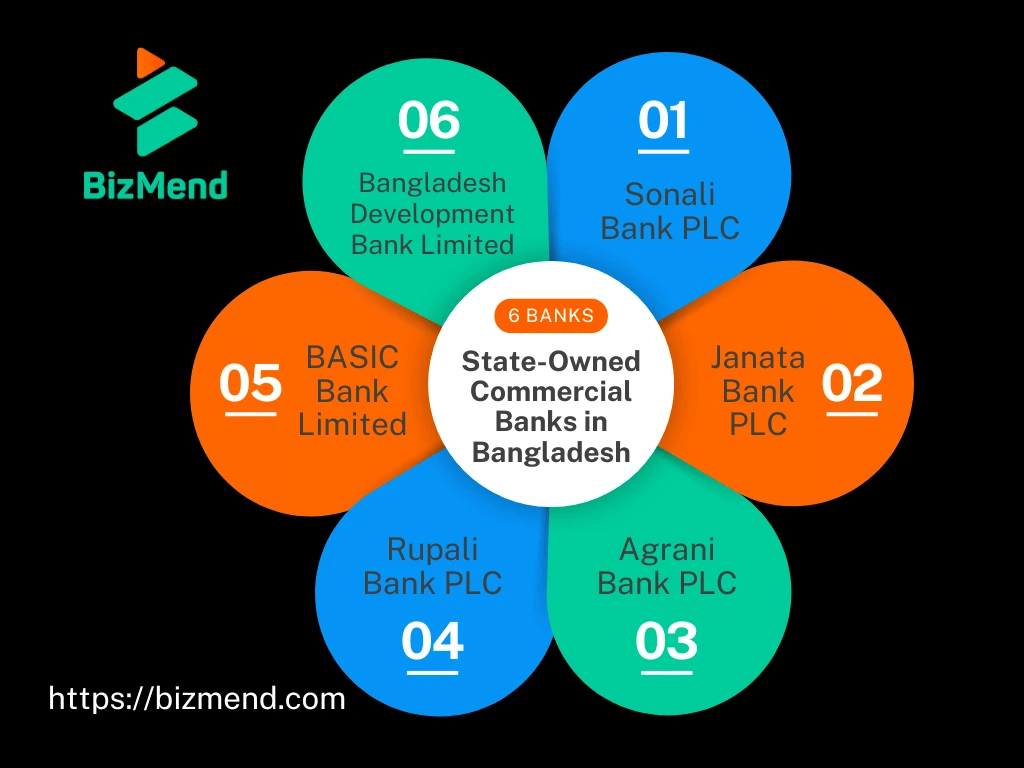
If private banks are where innovation brews, state-owned commercial banks are where Bangladesh keeps its backbone steady. These six giants don’t just handle money; they move ministries, manage millions of salaries, and keep the country’s financial blood flowing through pensions, remittances, and infrastructure projects. Each plays a different role, but together, they write the budget’s bottom line.

A Short Glance
Sonali Bank is the elephant in the room. Not just because it’s the largest state-owned commercial bank, but because it plays a key role in handling government payrolls, pension disbursements, treasury functions, and public project financing. It’s the first stop for many public-sector activities, from BOI/BIDA compliance to education board salary clearances.
Why It’s One of the Best
Core Facts & Capabilities
Special Services for Foreign Entrepreneurs

A Short Glance
If you’re looking at industrial backbone banking, Janata Bank fits the bill. It’s a go-to for export-import LC services and public sector-linked business financing. Despite bureaucratic overtones, it remains one of the more agile public banks in large-scale transactions.
Why It’s One of the Best
Core Facts & Capabilities
Special Services for Foreign Entrepreneurs

A Short Glance
Agrani wears multiple hats. It’s the foreign exchange bank of the public sector and a major remittance receiver. From rural remittances to trade finance, Agrani has mastered the art of balancing government reliability with public reach.
Why It’s One of the Best
Core Facts & Capabilities
Special Services for Foreign Entrepreneurs

A Short Glance
Rupali is the banker of pensions, gratuities, and municipal programs. It’s rooted deeply in public infrastructure projects and serves thousands of semi-government officials.
Why It’s One of the Best
Core Facts & Capabilities
Special Services for Foreign Entrepreneurs

A Short Glance
BASIC was founded for SMEs. But over the past decade, it has battled governance issues and is now under tighter regulatory oversight. It still offers limited services, especially to rural or micro entrepreneurs.
Why It’s One of the Best
Core Facts & Capabilities
Special Services for Foreign Entrepreneurs

A Short Glance
Formed from the merger of Bangladesh Shilpa Bank and Bangladesh Shilpa Rin Sangstha, BDBL is the industrial project bank. If your game is infrastructure, long-term capital, or factories, this is your player.
Why It’s One of the Best
Core Facts & Capabilities
Special Services for Foreign Entrepreneurs
All six SOCBs play a different, but often essential role, depending on your business type or funding source. If you’re diving into any of the areas mentioned below:
…knowing which public bank suits what will help you avoid red tape and wasted weeks. And yes, we’ll cover more of that in topics like loan eligibility for foreigners, BIDA approval, and company types foreigners can register; so, if you are interested in learning more, make sure to check our blog page and find out the right blogs for the right answers.
These banks don’t compete for your daily deposits or city-center branch selfies. They exist for missions. Agriculture. Expat welfare. Rural growth. They don’t often make headlines, but when it comes to pushing deep development or supporting overlooked communities, they punch far above their weight.
Let’s break down who’s who.

A Short Glance
Established in 1973, Bangladesh Krishi Bank (BKB) was born to serve the nation’s roots, literally. Krishi means agriculture, and this bank exists to make sure our farmers don’t just dream, but sow, reap, and thrive.
Why It’s One of the Best
Core Facts & Capabilities
Special Services for Foreign Entrepreneurs

A Short Glance
Focused solely on the northwest zone, especially Rajshahi and Rangpur. Think of Rajshahi Krishi Unnayan Bank (RAKUB) as BKB’s local twin, but specialized for drought-prone, underdeveloped regions.
Why It’s One of the Best
Core Facts & Capabilities
Special Services for Foreign Entrepreneurs
To learn more, check out our blog: Specialized Bank in Bangladesh.
Okay, so we’ve walked through the giants. The scheduled ones. The banks you hear about are in salary accounts, LC transactions, and BIDA paperwork.
But Bangladesh being Bangladesh, there’s always a side road. A lane where the lesser-known, government-formed banks work, not under the regular Bank Companies Act, 1991, but still wearing a government badge. These are the non-scheduled banks.
They’re not under Bangladesh Bank’s daily scrutiny. They don’t operate across every city. But they serve highly specific communities: rural savers, jobless youth, cooperative groups, or trained defense members, groups that commercial banks often don’t reach.
They’re not your first pick for opening a business account, but if you’re researching public banking in Bangladesh, you need to know they exist.
Let’s meet the quiet four.
If you’ve come across the name Jubilee Bank in old articles or bank lists, here’s the real story:
Jubilee Bank was once a registered entity, but it no longer exists. The government formally dissolved the bank following concerns about its viability and operations. Its registration was revoked by the RJSC (Registrar of Joint Stock Companies and Firms), and by early 2022, the High Court issued a formal order to liquidate it.
A final winding-up notice appeared in the government gazette around March 2021, making the closure official.
So if you see Jubilee Bank mentioned anywhere as a functioning government bank, you’re looking at outdated information. Today, it’s no longer in the picture.
Let’s face it: just naming the government banks in Bangladesh doesn’t help unless you know which one’s actually useful for what you’re trying to do. So here’s the part where we stop talking like a list and start talking like real advisors.
If you’re…
Whether you’re setting up in a Hi-Tech Park in Gazipur or planning a manufacturing unit inside BEZA’s economic zones, your capital injection, repatriation clearance, and foreign investor paperwork need a bank that knows how the system flows.
Go with:
They’ve handled investor visas, repatriation certificates, and even direct currency swaps.
This is often the first big hurdle. The form might be short, but the process? Not so much. You’ll want a bank that’s not just aware of foreign business needs but actively handles them.
Go with:
These banks are also listed in most BIDA and visa documentation for recommended service providers.
You’re a foreign entrepreneur trying to tap into Bangladesh’s loan ecosystem, but not all banks are equipped to handle this with non-resident founders.
Check if these are part of your funding pipeline:
Some of these institutions are also referenced in programs under Startup and SME Loans for foreign applicants.
Also, keep them in mind when you need to…
And fulfilling other compliance requirements that come with registering a company in Bangladesh.
If you’re serious about starting or scaling your business in Bangladesh as a foreign founder, these banks aren’t just financial institutions; they’re part of the paperwork. Literally.
While government banks hold the roots of public finance, private and foreign banks shape much of the country’s modern banking story.
As of now, 43 private commercial banks operate in Bangladesh, divided into:
There are 9 foreign commercial banks in operation, most with limited branches but strong global backing.
They don’t chase headlines, but they are very important if you do business across borders, send money to people in other countries, or handle corporate banking for global companies.
In short?
Government banks might be the gatekeepers, but private and foreign banks are often the bridges, especially for those entering the market from overseas.
Government banks aren’t flashy. They don’t headline startup angel networks or boast sparkling apps. But when it comes to:
They hold the key. And as Benjamin Franklin said,
“A small leak will sink a great ship.”
If you want to do business or invest in Bangladesh, understanding your government banks is not an option; it’s a must. Because a bit of information gap or inconsistency can cost you a lot.
They may not be the cutest in your pitch deck, but when the system needs structure, they’re the ones holding it steady.
Answer: Yes, but it’s not instant.
You’ll need proper paperwork like your passport, BIDA or work permit approval, and business registration documents. Banks like Sonali, Janata, and Agrani regularly handle foreign business and expat accounts, but expect some back-and-forth, and always double-check with their foreign desk, if they have one.
Answer: In this case, Sonali Bank PLC is your safest bet.
It’s often the default pick on official forms and project applications. Whether you’re bringing in capital or applying for repatriation clearance, Sonali’s familiarity with BOI/BIDA-linked services makes it a key player, especially for projects tied to getting BIDA Approval or starting in BEZA or Hi-tech parks.
Answer: Usually, yes. But not always.
Think of government banks in Bangladesh like old steam engines: not the fastest, but powerful and deeply connected to public systems. If you’re doing anything that involves government paperwork, visa approval, taxation, or long-term infrastructure, these banks are actually more aligned than some fast-paced private ones.
Answer: You can. But not all banks offer it openly to foreigners.
BASIC Bank is SME-focused (though proceed with caution), while Janata and BDBL handle project loans and startup capital in specific sectors. You’ll often need to show local traction, a registered entity, and in some cases, a resident director. Check the specific eligibility under Startup and SME Loans for foreign applicants.
Answer: Sonali Bank and Agrani Bank lead here.
They’re trusted by BIDA and the Bangladesh Bank to verify audited reports, process clearance certificates, and handle the actual foreign transfer. Just make sure your books are clean, and your exit route is as planned as your entry.

Learn how to open a bank account in Australia: eligibility, documents, fees, and step-by-step process for residents, expats, and students.

Learn how to open a bank account in Pakistan: eligibility, documents, fees, and step-by-step process for residents, expats, and students.

Choose smarter with the Top 10 private banks in Singapore—ranked by AUM, digital maturity, awards, and local presence; compiled from…