

How to Open a Bank Account in Australia
Learn how to open a bank account in Australia: eligibility, documents, fees, and step-by-step process for residents, expats, and students.

Definition & role: Profit-seeking, Bangladesh Bank–regulated institutions that take deposits, lend, and keep the economy’s day-to-day money moving. System map (2025): Blog cites 59 commercial banks (41 private, 8 state-owned,...
Let’s start with this: how many apps do you have on your phone for money stuff? bKash, Nagad, maybe an app or two from your bank? We rely on them like second nature. But beneath all this digital convenience sits something much older and bigger: the commercial banking system. It’s not just where you park your salary. It’s what keeps the country’s economy breathing.
And yes, I get it. Banking talk sounds dry. But stick around, because I’m about to make this real. So, Folks, let’s talk about commercial banks in Bangladesh.
Imagine a place that doesn’t just keep your money safe but makes money by using yours. That’s a commercial bank.
Definition: A commercial bank is simply a place where people and businesses keep their money, borrow when they need to, and the bank earns its living through interest, fees, and the services it offers.
Objective: Serve public interest while making a profit. Yep. Two birds. One bank.
These banks aren’t charity houses. They want to grow. But they still need to follow Bangladesh Bank’s rules and serve common people, small businesses, corporates, and even foreign investors trying to break into Bangladesh’s booming sectors.
Example? City Bank giving out SME loans to rural businesses. BRAC Bank helping freelancers open accounts digitally. Or Commercial Bank of Ceylon processing cross-border remittance from the Maldives.
The structure of banking in Bangladesh is like a pyramid:
At the top? Bangladesh Bank (the central bank), the big regulator.
Under that:
All of them are closely watched by the Bangladesh Bank, following rules like Basel III and Anti-Money Laundering guidelines. If you’re wondering how these rules actually work in real life, just check out the red, yellow, and green zone indicators used to show different levels of risk in the country’s banking system.
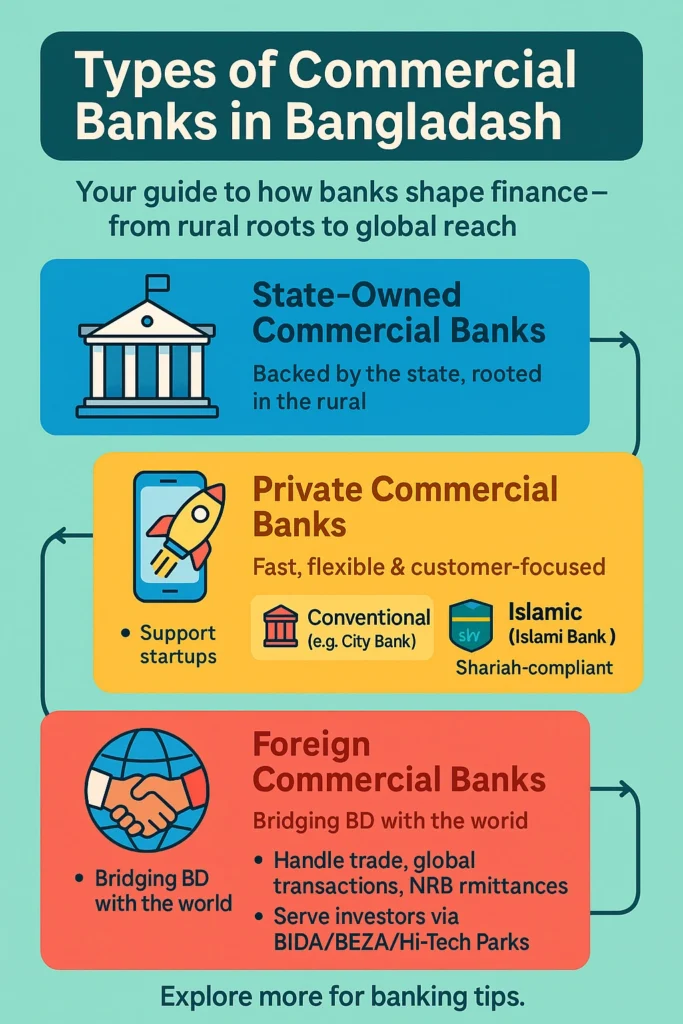
Yeah, not all commercial banks wear the same suit!
You see “commercial bank” and might assume it’s just one thing. But in Bangladesh, these banks come in three distinct flavors, each serving a slightly different role in the big financial puzzle.
Here’s how they’re split:
Also called SoCBs, these are the oldest players, backed by the government. Think of them as the dependable, all-rounders who still run many of the essential public services.
This is where most of the action happens now. They’re independently owned but follow strict rules set by the Bangladesh Bank.
These are often the go-to for foreigners setting up businesses or opening accounts. If you’re curious, start with topics like How to Open a Business Bank Account in BD as a Foreigner.
They’re not just running branches in Bangladesh. They’re building bridges between Bangladesh and the global financial stage.
If you’re an investor working under BIDA, BEZA, or in a Hi-Tech Park, these banks often step up with customized support, especially when it comes to things like sending profits back home or registering your foreign-backed company.
As of 2025, Bangladesh’s financial sector includes:
| Type of Bank | Count |
| Total Scheduled Banks | 62 |
| Total Commercial Banks | 59 |
| – Private Commercial Banks | 41 |
| – State-Owned Commercial Banks | 8 |
| – Foreign Commercial Banks | 9 |
| – Digital Commercial Bank | 1 |
| Specialized Banks (like BKB, RAKUB) | 3 |
| Other Non-Scheduled Institutions | 5+ |
Yes, that’s a lot of banks, but not all are equal when it comes to tech, capital strength, or customer service.
Here’s a breakdown of the major commercial banks by type:
| Name | Type | Year Established | Website |
| Sonali Bank Limited | State-Owned | 1972 | sonalibank.com.bd |
| Janata Bank Limited | State-Owned | 1972 | janatabank-bd.com |
| Agrani Bank Limited | State-Owned | 1972 | agranibank.org |
| Rupali Bank Limited | State-Owned | 1972 | rupalibank.org |
| City Bank | Private Commercial | 1983 | thecitybank.com |
| BRAC Bank | Private Commercial | 2001 | bracbank.com |
| EBL (Eastern Bank Limited) | Private Commercial | 1992 | ebl.com.bd |
| DBBL (Dutch-Bangla Bank Limited) | Private Commercial | 1995 | dbbl.com.bd |
| Islami Bank Bangladesh Limited | Private Commercial (Islamic) | 1983 | islamibankbd.com |
| Commercial Bank of Ceylon (BD) | Foreign Commercial | 2003 (BD branch) | combank.net.bd |
Note: To see the entire current list of all private, state-owned, and international commercial banks, check out official Bangladesh Bank directories and trusted sources.
Let’s not reduce banks to just account openers or loan pushers. In Bangladesh, commercial banks wear multiple hats, and if you look closely, they quietly power everything from your online purchases to infrastructure projects. Here’s how they actually work:
1. Safekeeping Your Money (Deposits)
This is the most basic function, but also the most vital.
2. Lending & Credit Support
Banks turn deposits into opportunity by lending to:
Foreigners setting up shop? Yes, banks also provide business loans to approved foreign entrepreneurs, as long as you meet the local compliance steps.
3. Handling Trade & Remittance
Whether you’re sending goods abroad or sending money home:
This is crucial for NRBs and anyone operating across borders.
4. Digital Banking Tools
Banking’s gone mobile. literally.
5. Agent Banking & Rural Inclusion
Here’s where banking goes beyond Dhaka or Chattogram.
In short? Commercial banks in Bangladesh don’t just move money. They move people toward growth, safety, and bigger dreams.
Let’s not sugarcoat it; lending money is a gamble. Whether it’s a big company asking for working capital or a small shopkeeper applying for a seasonal loan, there’s always that looming question: Will they pay it back?
That’s where credit risk management comes in. For commercial banks in Bangladesh, this isn’t just a compliance checkbox. It’s a daily survival skill.
It’s the possibility that a borrower won’t pay back the loan on time, in full, or at all. And for a bank, even a small rise in defaults can shake the entire system. Especially in an economy like Bangladesh, where thousands of businesses still rely on bank loans to grow.
Let me break it down like we’re having a lively conversation over a cup of coffee:
Banks rely on independent credit rating agencies like CRISL, Alpha Credit Rating, and Emerging Credit Rating to get a clearer picture of who they’re lending to. These agencies dig into how steady your income is, how you’ve handled loans before, and whether you usually pay on time. If your score doesn’t meet the mark, the bank might turn you down or ask for extra security before moving forward.
The central bank doesn’t just sit around. It lays down clear rules through what’s known as the risk-based capital adequacy framework (yep, that’s part of Basel III). In simple terms, it means every bank has to keep a safety cushion of capital, depending on how big and risky its activities are. Sort of like saving up just in case some loans don’t get paid back.
This one matters. NPL (Non-Performing Loan) ratio tracks how much of a bank’s loan portfolio has gone sour; i.e., unpaid for 90 days or more. If that number creeps too high, Bangladesh Bank flags it. And public trust? It wobbles badly.
As of early 2025, private banks are keeping NPLs below 5%, but some state-owned banks still hover above 10%. That’s where tighter control and recovery efforts kick in.
If you’re planning to open a business bank account in Bangladesh as a foreigner, or looking into SME loans, or even aiming to invest in one of Bangladesh’s Hi-Tech Parks or BEZA zones, your bank’s credit health affects your financial experience.
Think about it:
So yeah, credit risk sounds like a banker’s term. But at the end of the day, it shapes how stable, safe, and helpful your bank can actually be.
If you’re wondering what banks have to do with Bangladesh’s roads, ports, factories, or tech zones, here’s the answer: a lot.
Think of them as silent partners in Bangladesh’s GDP growth engine.
Things are changing. Fast. Like bullet trains, or maybe like something else! And…
If you’re someone setting up in BEZA or a Hi-Tech Park or applying for BIDA clearance, commercial banks are more relevant to your plan than ever.
Let’s be real: commercial banks in Bangladesh are no longer just quiet buildings with long queues and dusty forms. They’re becoming part of your phone, your startup journey, your remittance lifeline.
So next time you think a bank is just for storing money, remember: it’s actually moving the country forward.
Answer: As of 2025, there are 58 commercial banks running across Bangladesh. That number brings together a mix: some are state-owned, some privately owned, and a handful are foreign banks doing business here, too. It’s a pretty diverse lineup serving everything from local communities to global investors.
Answer: Sonali Bank is the largest state-owned one by assets. Among private banks, BRAC Bank and Islami Bank lead the pack.
Answer: Bangladesh has state-owned commercial banks, private commercial banks (both conventional and Islamic), and foreign or international commercial banks.
Answer: They fund businesses, manage remittance, drive savings, and support government projects, playing a vital role in GDP growth and job creation.
Answer: It’s the process of ensuring that banks don’t suffer huge losses due to unpaid loans. Tools include borrower profiling, credit ratings, and policy compliance.

Learn how to open a bank account in Australia: eligibility, documents, fees, and step-by-step process for residents, expats, and students.

Learn how to open a bank account in Pakistan: eligibility, documents, fees, and step-by-step process for residents, expats, and students.

Choose smarter with the Top 10 private banks in Singapore—ranked by AUM, digital maturity, awards, and local presence; compiled from…