

How to Open a Bank Account in Australia
Learn how to open a bank account in Australia: eligibility, documents, fees, and step-by-step process for residents, expats, and students.

What BB is: Bangladesh’s central bank (est. 1971/BB Order-1972), HQ Motijheel; state-owned, legally autonomous; Governor appointed by GoB. Core job: Keep prices stable and growth steady via Monetary Policy Statement...
“Money is not the only answer, but it makes a difference.”
—Barack Obama
Ever wondered who decides how much cash your wallet can actually buy each month? Or why does your home loan interest rate jump overnight while your salary doesn’t?
That, my friend, is usually the silent hand of Bangladesh Bank at work.
This blog isn’t a classroom lecture. It’s a walk-through for anyone who has ever opened a bank account, transferred money abroad, started a business, or is just curious about what this mysterious “central bank” actually does. Let’s talk about purpose, power, people, and perception—the core 4Ps of Bangladesh Bank. And how they affect you, not just the headlines.
Bangladesh Bank (BB) isn’t just some upper-floor government office with suited officials. It’s our central bank, the apex body that holds the strings to Bangladesh’s entire financial ecosystem.
And here’s where the everyday connection starts:
But no, BB won’t give you a debit card or a loan. It’s the bank that your bank obeys.
That Taka note in your hand? BB printed it.
That bank loan interest hike? BB pulled the trigger.
That alert about a bank in crisis? BB’s warning label.
It might not be in your inbox, but it’s very much in your wallet, your EMI, your savings, and your monthly grocery list.
Let’s talk about the role of the Bangladesh Bank, without overcomplicating it. Here’s a brief list of what this central bank actually does, in ways that quietly shape the finance of the country, your day, your business, and your bottom line:
When the price of groceries creeps up faster than your paycheck, BB adjusts how expensive it is for banks to lend or borrow money. That directly impacts your home loan rate or the cost of running a business.
Every single Taka note in your wallet, legally stamped and circulated by BB. It also manages how much foreign currency enters or exits the country, keeping the USD-BDT balance from becoming a panic button.
Too much cash in the market? Prices explode. Too little? Growth stalls. BB controls that thin line by setting how much money banks can actually loan out, using tools like CRR (Cash Reserve Ratio) and SLR (Statutory Liquidity Ratio).
From big-name commercial banks to specialized and non-scheduled ones, BB plays referee. It monitors their health, checks risk levels (think Red Zone talk), and pushes banks to fix their act, or merge, if necessary.
For any foreign investor trying to send money in, or pull profits out, BB steps in. From approving foreign loan flows to verifying repatriation requests, it links up with BIDA, custom authorities, and even local banks.
Twice a year, BB lays out its action plan for the economy: interest trends, liquidity expectations, foreign exchange outlook. It’s called the Monetary Policy Statement, and if you’re a startup, factory owner, or export manager, you should keep an eye on it.
It also quietly signals what’s coming; whether credit will get tighter or cheaper, giving banks and businesses a feel for the financial weather ahead.
BB is also the one standing between you and a potential banking crisis. If a bank’s lending becomes reckless, BB doesn’t just “watch,” it steps in. From audit orders to limiting withdrawals, it works to protect the everyday depositor.
Bangladesh Bank holds accounts for ministries, manages public debt instruments, and processes large-scale disbursements like salary payments for government employees. It’s the reason Sonali Bank, for instance, channels public payroll or pension funds—BB coordinates the backend.
Every card swipe, BEFTN transfer, or MFS transaction? Runs through the systems BB supervises. It ensures banks, mobile wallets, and even fintech startups don’t play fast and loose with your money’s movement. This is also how interoperability between bKash, Rocket, and traditional banks gets smoother every year.
When a bank hits a liquidity wall, like not having enough to pay back depositors, BB decides whether to offer emergency funds. This is how it stops fear from turning into a full-blown bank run. It’s a big reason why your savings don’t just disappear during crises.
BB leads the financial side of anti-terror and anti-corruption efforts. Through the Bangladesh Financial Intelligence Unit (BFIU), it tracks suspicious transactions and issues alerts. If someone tries to mask shady transfers as remittance or fake trade, this is the watchdog catching it.
Beyond big banks and top CEOs, BB also pushes banks to reach farmers, women-led microenterprises, and underserved regions. Its agent banking policies, digital banking approvals, and rural banking mandates are how startups and villagers can open accounts without stepping into a bank branch.
Behind every budget policy or interest cap debate, you’ll find BB’s quiet reports. From publishing data on inflation to advising the Ministry of Finance, BB plays a key role in steering national decisions, often before they’re made public.
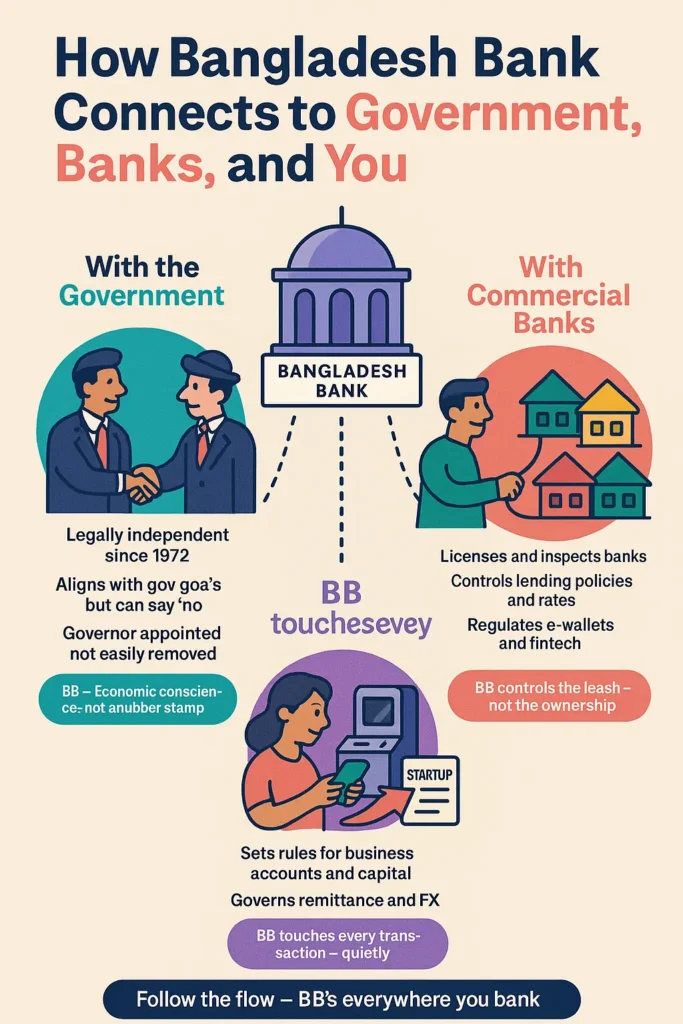
Bangladesh Bank sits in a strange but powerful position. It’s not a typical ministry, and it doesn’t change with elections. Yet, it works side-by-side with the Ministry of Finance and other regulators like NBR or BIDA.
Here’s how it all flows:
Bangladesh Bank doesn’t sit back and hope the economy behaves. It intervenes, deliberately, and often silently, with a toolkit that’s tested and backed by law.
Here’s how BB keeps your taka from losing its value, your loan from becoming impossible, and the whole system from going off the rails:
Think of this like the interest BB charges or pays when it deals directly with commercial banks.
Together, these rates tell banks: Should you lend more, or hold back? And that ripple hits everything from your EMI to business capital.
This is the minimum amount of cash a bank must keep parked with the Bangladesh Bank; untouchable, unloanable. It’s a buffer.
Why? Because if every customer came knocking for their money at once (a bank run), this reserve is the emergency vault. It also helps tighten the money supply when inflation’s rising.
This one’s like the cousin of CRR, but instead of cash, it includes safe assets like treasury bills, gold, and bonds.
BB uses SLR to make sure banks don’t overextend themselves. If the market is getting “too hot,” BB tells banks to stash more in these liquid assets, cooling the economy gradually without panic.
Twice a year, BB lays its cards on the table.
This isn’t just paperwork. It’s a directional signpost for the next six months, covering everything from inflation targets to lending trends, reserve levels, and exchange rate predictions.
If you’re a business owner, a startup, or someone saving up for a big investment, this document tells you: Is the tide in your favor, or is it time to wait it out?
Bangladesh Bank also shapes how imports happen, clears exports, and approves digital payments, affecting everything from cross-border eCommerce to how fast fintech grows.
Because Bangladesh Bank quietly shapes your financial life:
Even for something like Trademark Protection or Setting Up in BEZA or Hi-Tech Parks, your finances eventually pass through a BB checkpoint.
So you’re not a Bangladeshi citizen, but you’re investing, exporting, or opening a branch here? Well, you’re already under Bangladesh Bank’s umbrella.
In short, Bangladesh Bank might not be on your company’s letterhead, but it’s always on your balance sheet.
Bangladesh Bank is not a passive observer; it’s the regulator both government and private banks report to. Whether it’s Sonali Bank disbursing salaries or a flashy private bank launching a digital app, BB sets the rules. From how much they can lend, to how they manage risk, to who they can onboard as clients, it’s BB’s call.
And foreign banks operating in Bangladesh? Yes, they’re here too; Standard Chartered, HSBC, but even they must play by BB’s policy book. No one gets a free pass.
In the end, if banks are the players, BB is the referee. Quiet, firm, and always watching the score.
You may never shake hands with the Governor (the Bangladesh Bank Governor, I mean). But your wallet, your EMIs, your remittance from Dubai, your startup capital, all touch our central bank’s policy.
It doesn’t just regulate banks. It regulates our confidence in the Taka, our faith in savings, and the pulse of Bangladesh’s economic life.
Bangladesh Bank isn’t a loud institution. But its silence often speaks louder than the budget speech.
“Central banking isn’t about controlling everything. It’s about keeping what matters steady.”
And that’s what BB quietly does.
Answer: Because unchecked lending can crash an economy. If banks lend too much, prices shoot up. If they hold back, businesses choke. Bangladesh Bank finds the sweet spot, deciding how much money stays put and how much moves. It’s like handling a water tap: too tight or too loose, and the whole system feels it.
Answer: Not directly. Yes, the government chooses the Governor, but Bangladesh Bank strictly follows the Bangladesh Bank Order, 1972. And that Order gives the bank room to breathe when it comes to things like monetary policy, oversight, or dealing with inflation. Think of it like a referee in a game; it’s close to the action, but it doesn’t take sides.
Answer: Yes, but not at random, if I’m being honest. Bangladesh Bank can temporarily suspend your account for inquiry, through its Financial Intelligence Unit (BFIU), if it looks like you’re laundering money, funding terrorism, or making huge transfers that don’t make sense. It’s like stopping, not freezing or canceling entirely.
Answer: Because printing money isn’t about having “more,” it’s about avoiding “too much.” Too much cash chasing the same number of goods means inflation. BB checks inflation, reserves, and money demand before even touching the print command.
Answer: Every time dollars flow in (remittance, exports) or out (imports, foreign education), BB watches. It holds USD reserves and intervenes when the taka is in trouble. Whether you’re sending money abroad or converting your earnings, BB’s decisions shape how far your taka goes.
Answer: Absolutely. BB monitors the health of all banks using strict benchmarks for capital adequacy, default loan ratios, and management quality. When a bank enters risky territory, BB marks it Red or Yellow, pushing it to improve. It’s like a traffic light for depositors: red = proceed with caution or don’t proceed at all.

Learn how to open a bank account in Australia: eligibility, documents, fees, and step-by-step process for residents, expats, and students.

Learn how to open a bank account in Pakistan: eligibility, documents, fees, and step-by-step process for residents, expats, and students.

Choose smarter with the Top 10 private banks in Singapore—ranked by AUM, digital maturity, awards, and local presence; compiled from…